&
Patent Term Extensions in the Eurasian Region. Part 2: Eurasian Patents
23.10.26
Georgii Stoiko, Diana Galukhina
In this post we present some statistics about Patent Term Extensions (PTE) that can be obtained from the Eurasian patent register for PTEs. As a reminder, Eurasian patents are granted by the Eurasian Patent Organization and provide protection in 8 countries in the region. This post continues the previous one.
Contents at a glance:
- Quick introduction
- PTE record
- Figures
- Extended Subject Matter
- Durations
- Flexibility
- Key takeaways
Quick introduction
The right to request a PTE was introduced into the Eurasian patent system in January 2004. Since 2005, the Eurasian system has provided a unitary procedural framework, while the exact conditions under which PTEs are granted, including the calculation of terms and deadlines, have mirrored the national conditions.
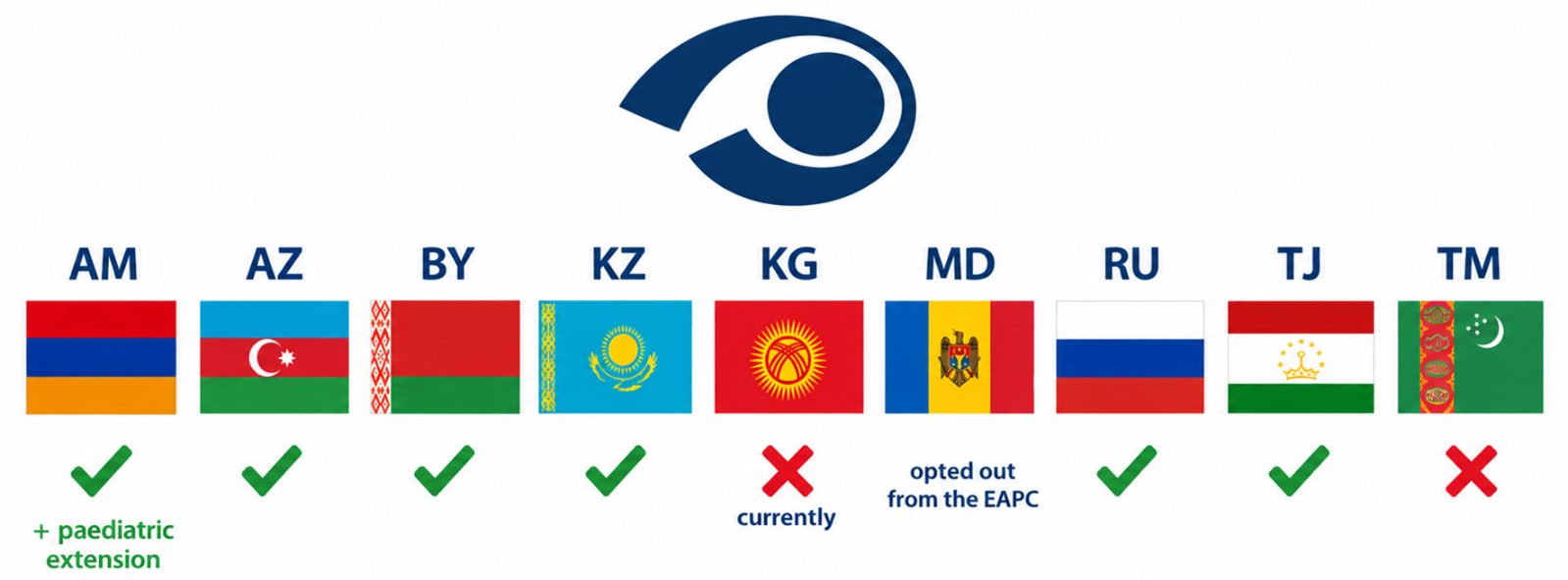
Among the state-parties, TM does not provide for PTEs. Despite MD patent extensions are seen in the figures below, MD denounced the EAPC in 2012, so the corresponding numbers will naturally fade away. KG used to provide PTEs, but abolished them in 2015. That is, only 6 EA members currently provide for PTEs.
The first PTEs were granted on June 30, 2006, and related to Bextra, Dynastat (both by G.D. Searle & Co.), and Zoloft (Pfizer Products Inc.).
The scope of the extended right is determined by (1) claim(s) number and (2) the product, for which authorization serves as the ground for the PTE. This definition may still pose challenges for accurately delineating the scope of extended rights, which shall be done on a case-by-case basis. To date, there have not been any landmark judicial disputes that have dealt with this aspect, unfortunately.
By the way, at the launch, the system seemed to be harmonized with the national provisions of the state parties to the EAPC, but currently it is not, because, e.g., Russian law now requires that specifically narrowed claims be filed along with a PTE request.
PTE record
A typical record contains the following information:
- Filing date of the PTE request;
- Patent number, kind code;
- Patent holder (current);
- Country code for which the PTE is requested;
- Product’s marketing authorization (MA) certificate number and date;
- Product’s name (trade and optionally INN);
- Claims for which PTE is granted;
- PTE expiration date;
- Publication date, bulletin number.
Figures
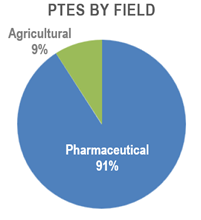
For the years 2006-2025, we have identified a total of 705 PTEs pertaining to 369 patents.
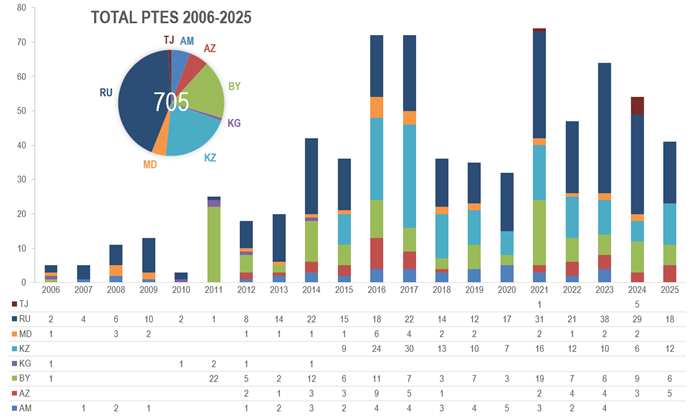
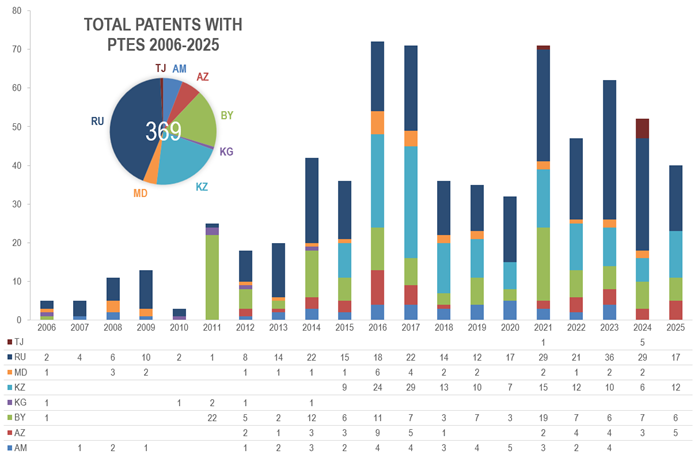
The majority of PTEs relate to medicaments and veterinary drugs (641), pesticides and agrochemicals share the rest (64).
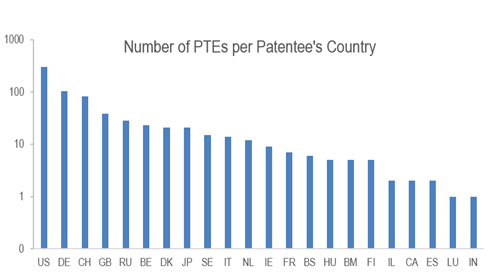
Through 2025, the US is cumulatively the top source of holders of Eurasian patents with PTEs. Among the state parties to the EAPC, only RU is present, holding the 5th position. China is not visible in the diagram below, though it only accounts patentees recorded at the dates of granting the PTEs; some PTE-ed Chinese-sourced inventions had been assigned to Western counterparts, as is the case of, e.g., BeiGene. Anyway, Chinese patentees are yet to take their top position in the rating in the years to come.
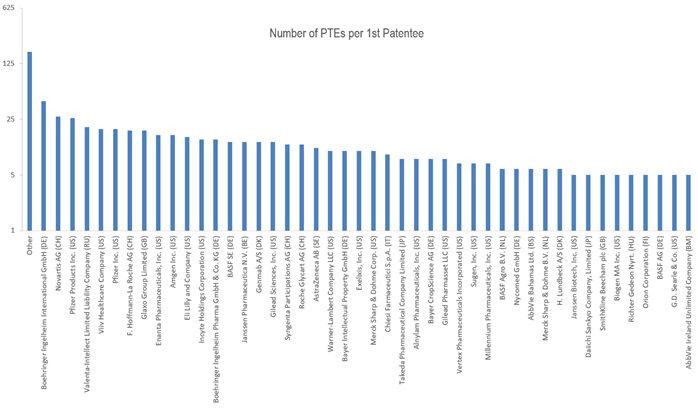
The top 3 companies holding Eurasian PTEs are Boehringer Ingelheim International GmbH (42), Novartis AG (27) and Pfizer Products Inc. (26), respectively. The majority of PTEs for the recorded period (177) belong to patentees that have 4 or fewer Eurasian PTEs in total. The only company located in an EAPC member state and holding more than 4 PTEs is Valenta-Intellect LLC (RU).
Extended Subject Matter
While the Eurasian procedure for PTE is a framework, it has to be kept in mind that the member states are diverse in what is eligible for PTE.
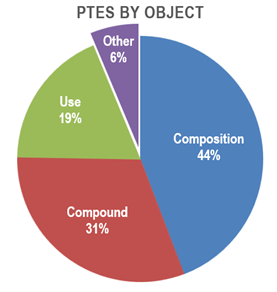
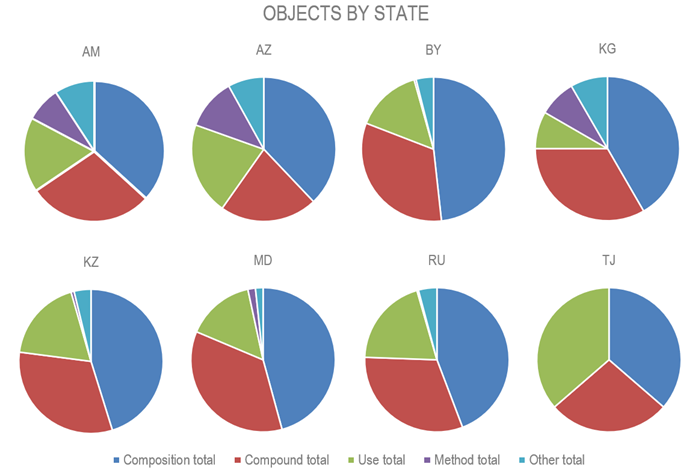
Anyway, the most natural leaders are composition and compound, accounting in total for 75% of all subject matter. Compositions shall mean here a broad range of terms/products: “composition”, “formulation”, “tablet”, “solution”, “(co)suspension”, etc., as well as “combinations” insofar as they do not extend to a concept of separated entities.
Among compounds, you can find predominantly small molecules and biologicals (proteins, antibodies, conjugates, multimeric compounds, nucleic acids); crystalline forms are especially abundant among secondary subject matter. The most peculiar subject is “virus” and “virus population” (EA005952, Rotarix).
Use-type claims, which usually define an indication-limited product, are also common extendible subject matter despite not being directly mentioned in the national legislations.
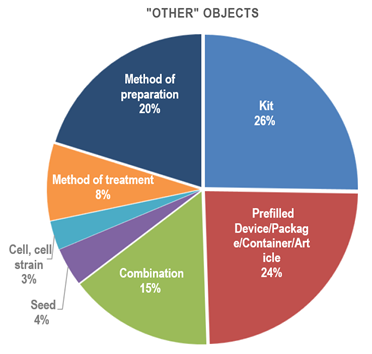
Other subject matter mainly breaks down into products that do not belong in the above common categories, and methods. The products include:
- Kits, which usually relate to a packaged pharmaceutical product (EA013427, 014232, etc.);
- Combinations, which relate to two or more APIs to be taken together or separately (EA014840, 016079, 016166, etc.);
- Devices; this subject matter may seem counterintuitive since devices per se are not eligible for PTE, but in each case these inventions relate to devices prefilled with a composition, such as aerosol sprays or syringes, that are pharmaceutical products (EA021917, 023470, etc.);
- Cells and cell strains (EA021242 (AM), “Xgeva”-related); and
- Pesticide-treated seeds (EA012667, 013081).
Methods, both preparation and treatment, are currently allowable for PTE in AM and AZ only, but in the 2010s they were also sporadically granted in other member states.
Across member states, the “compound-composition-use” trinity accounts for at least 80% of extended subject matter (AZ) and up to 100% (TJ).
Durations
Extended protection
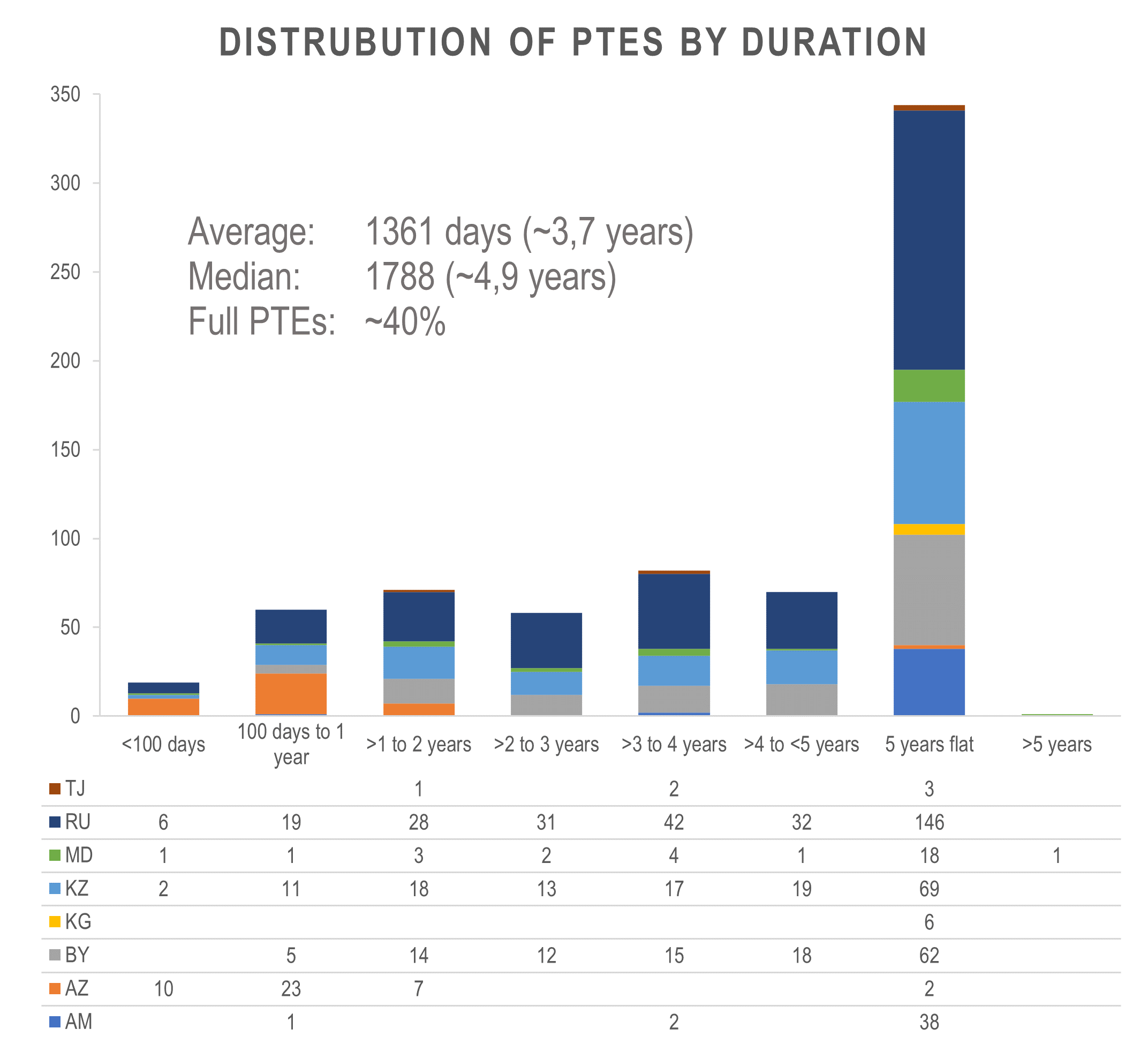
With some 40% of PTEs enjoying the maximum possible term, which is 5 years, the average and median terms are about 3 years 8 months and 4 years 10 months, respectively. The diagram below shows a per-year split with a rare case of a paediatric extension (Janssen’s Simponi in MD).
Procedure
The time frame for registering a PTE cannot be derived from the register, as we did for Russian patents in Part 1. However, since the job is a way simpler—no narrow claims have to be negotiated with the Eurasian examiner—the whole cycle may take from less than a month to 2 months.
Flexibility
One patent – many member states
It is common to obtain PTEs for the same patent in respect of more than one EAPC member state, because drugs are usually submitted for MA region-wide. Moreover, AM, BY, KZ, and RU are members of the EAEU, which currently imposes a unified and streamlined procedure for drug authorization and so potentially favors “batched” PTE registration.
One patent, one member state – many PTEs
This route is pretty normal: the majority of patents include broad claims protecting many potential products. Once a proper ground is obtained (MA), a further PTE request can be filed within an established deadline. For example, BASF’s EA030875 was PTE-ed in BY four times based on four different fungicides.
One patent, one member state, one product – many PTEs
This option is on the table as well. Exelixis’ EA026425 was extended twice in RU on the basis of Cabometyx. Viiv’s EA014162 – twice on the basis of Tivicay (and the 3rd time – based on Vocabria).
MSD’s EA034558 was extended twice in each of RU, KZ, and BY against Calquence, the first time for capsules containing acalabrutinib free base, the 2nd – for tablets containing a maleate salt thereof.
The Eurasian register does not refer to a specific MA certificate/record, but one of the most plausible explanations for multiple PTE is that newly approved indications for existing drugs serve as grounds for further PTEs. There is another example: a second PTE granted as a result of limitation of the patent by the patentee (EA009120).
One product - many patents with PTE
This is a very common option too. Examples include Braftovi (EA019722, 025222, 025389, 028420), Evenity (EA014525, 021539, 027039, 037392) and many more.
Key takeaways
Covering 6 countries (of the current 8 members) having a total population of some 200 mln, the Eurasian PTE system represents an indispensable tool, especially for pharma players. Since the launch, the PTE system has shown a growing trend fueled predominantly by American and European innovations. The procedure is comparatively quick and patentee-friendly, and is localized at the EAPO. The list of practically eligible subject matter is broader than one could expect. As soon as marketing authorizations are obtained, PTE requests may be filed while the patent is in force, thus forming a solid protection of innovations.
Court approaches regarding interpretation of the scope of extended patent protection are yet to be understood, but it worth noting that patent enforcement may vary from member to member, as this aspect is regulated in accordance with national laws.
NEWS
Other newsEAPO Opens Filing of Industrial Design Applications Under the Hague System
12.10.26
Eurasian Patent Office Joined Hague System
17.07.26
Domain Administration Rules in .ru, .рф and .su Zones to Change from September 1, 2026
14.07.26
Changes in the International Registration of Industrial designs
01.07.26
Supreme Court Review on Special Economic Measures
29.06.26
Russia's Constitutional Court Clarifies When Marketplace Operators May Avoid Liability for Third-Party IP Infringement
18.06.26
Development of Pharma IP Regulatory Framework
16.06.26
Dispute over Patentability of Ruxolitinib Salts Resolved in Favor of Originator
25.05.26
Abuse of Rights in Challenging Patents
25.05.26
Happy World Intellectual Property Day! 🏅
26.04.26
Six scholars, three courts, one answer: a distributor who secretly registers the principal's mark loses protection – in full
25.04.26
No evidence, no authorship: appeal court overturns RUB 5 million award in handbag design case
24.04.26