&

An Elegant Trick to Bypass the PTE Deadline vs. the Public Domain: Guess the Winner?
06.11.26
Forxiga (dapagliflozin), developed by BMS/AstraZeneca, is now making room for generics to squeeze in. In Russia, this process has been dramatically accelerated: the latest court case has shown that the SPC under RU2746132, which relates to the molecule and its composition, has been unenforceable since March 16, 2021.
This is not the end: the patentee appealed the decision on October 27, but the chances of success are vanishingly small.
The situation with RU2746132 has come to light before; however, this is a good moment to bring the entire story together and learn a lesson from it.
Prosecution
The entire scheme is summarized below:
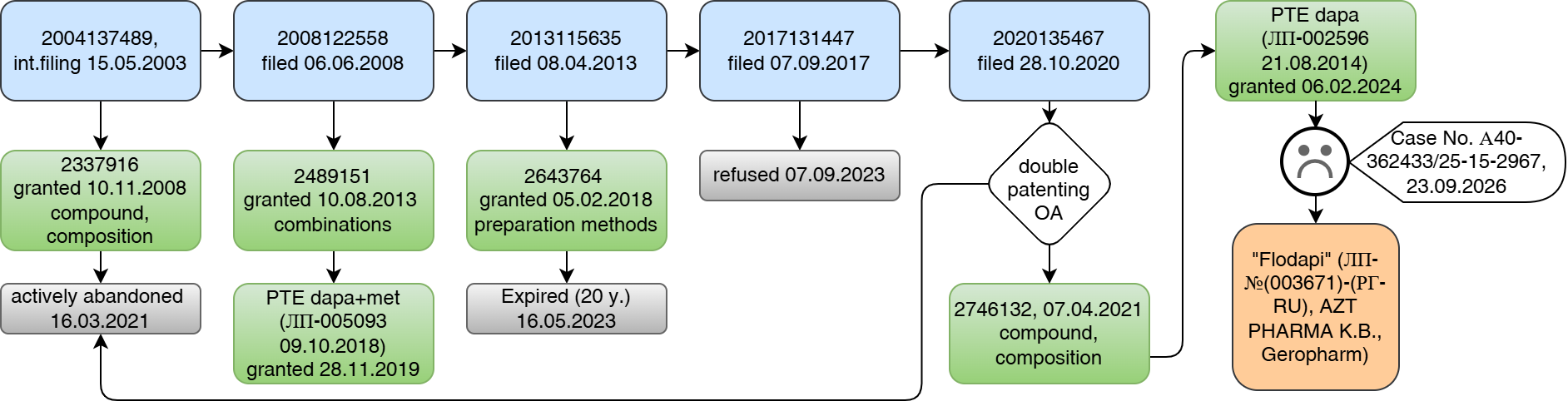
The first patent in the chain—RU2337916—was granted in 2008; Forxiga was authorized for marketing in Russia six years later, triggering the six-month deadline for filing a request for a patent term extension (PTE). This deadline—February 2015—was missed.
At that time, the patentee had a divisional application pending, which was split off to produce a terminal application—RU2020135467—that mirrored claims 1 to 3 of RU2337916, but with a slightly broader scope in claim 1, which included a dapagliflozin ester. This triggered an Office Action in which the examiner, referring to paragraph 1 of Article 1383 of the Civil Code, proposed either (1) narrowing the claims to the ester or (2) terminating RU2337916, thereby allowing all the pending claims of RU2020135467 to proceed to grant.
In response, the Applicant, “guided by paragraph 2 of Article 1383 of the Civil Code,” elected the second option. As an aside, the above situation fell into a grey zone: neither paragraph describes it: paragraph 1 refers to cases in which a patent has not yet been granted; paragraph 2 refers to identical applications relating to an invention and a utility model. This grey zone still exists.
Taking advantage of the reinstated deadline, the patentee proceeded to apply for a PTE in 2021 which was quickly granted for the full five-year period, until March 2028.
Enforcement
Then things went wrong. Marketing authorizations for generic drugs began to be issued as early as 2022, but companies were afraid to launch the drugs, with the exception of Akrikhin, which launched its “Fordiglif” in April 2024. Despite AstraZeneca’s initial success in antitrust proceedings against Akrikhin, the latter managed to protect its right to use the invention (Case СИП-298/2025). The court indicated that “[AstraZeneca] committed an abuse of rights when obtaining RU2746132, since the sole purpose of re-obtaining a patent for the invention then protected by RU2337916 (claim 3) was to restore the previously lost possibility of extending the term of the exclusive right to the pharmaceutical composition in question.”[1] AstraZeneca got bogged down in this case: the Supreme Court upheld the position of the court of first instance.
In 2026, AZT Pharma/Geropharm launched “Flodapi.” AstraZeneca sued the generic producers and lost. In its decision, the court again found an abuse of rights and explained that “…obtaining, and, in general, the very existence of a second valid patent for an invention identical to the first one, which has entered the public domain, does not constitute grounds for withdrawing the invention from the public domain, since this is a direct violation of the mandatory rule of Article 1364 of the Civil Code, as well as a violation of the public interest and the interests of individuals and business entities that lawfully use the invention in accordance with the said provisions of the law.”[2]
Consequences
Indeed, the dapagliflozin case is a dreadful experience for AstraZeneca. Forxiga is full-cycle manufactured at AstraZeneca’s own facilities in Russia under a special investment contract with the Ministry of Industry and Trade. Although Forxiga enjoyed an actual patent monopoly for some 10 years, it now turns out that about four years of the 25-year extended protection have been lost. Had generic producers not hesitated, the erosion of the monopoly could have started as early as 2021—the year in which the first patent was abandoned.
Root cause
The most plausible explanation for what happened is a failure in docketing and deadline management. It is clear that the relatively short—six-month—deadline for filing a PTE application was missed. In an attempt to outmaneuver the system, AstraZeneca creatively used the divisional-application route and obtained the desired PTE, which now appears to be ineffective.
The problem is that this deadline cannot be set upon grant of the first patent, since marketing authorization typically comes years later. To stay in control, the originator must establish a coordinated information flow among the local regulatory team (which reports on marketing authorizations), the in-house patent counsel (who monitors deadlines), and the external patent attorney (who files the PTE application).
[1] the case СИП-298/2025, the decision of December 2, 2025
[2] the case А40-362433/2025, the decision of September 23, 2026
NEWS
Other newsSuccessful Patent Invalidation at the Chamber of Patent Disputes
06.11.26
Rospatent to Be Empowered to Fine for Pharmaceutical Patent Infringement: Draft Law Published
02.11.26
Uzbekistan: Letters of Consent for Trademark Registration Must Now Follow New Rules
30.10.26
Patent Term Extensions in the Eurasian Region. Part 2: Eurasian Patents
23.10.26
EAPO Opens Filing of Industrial Design Applications Under the Hague System
12.10.26
Eurasian Patent Office Joined Hague System
17.07.26
Domain Administration Rules in .ru, .рф and .su Zones to Change from September 1, 2026
14.07.26
Changes in the International Registration of Industrial designs
01.07.26
Supreme Court Review on Special Economic Measures
29.06.26
Russia's Constitutional Court Clarifies When Marketplace Operators May Avoid Liability for Third-Party IP Infringement
18.06.26
Development of Pharma IP Regulatory Framework
16.06.26
Dispute over Patentability of Ruxolitinib Salts Resolved in Favor of Originator
25.05.26